
Kategoriler & Markalar▾
Kategoriler
Markalar
- Breakout , SM / MM53
- Patchcord (Duplex) Single Mode37
- PoE Injektör & Adaptör22
- Patchcord (Simplex) Single Mode19
- İç/Dış Ortam (Universal)16
- Güç Adaptörü & PSU16
- Role SSR Tetikleyiciler16
- Dış Ortam Kablolar16
- Elektronik Otomasyon15
- Sigorta , Devre Kesiciler15
- Patchcord (Duplex) Multimode OM315
- Lora Kablo , Anten , Aksesuar14
- Kontrol Kartları13
- Kurulum & Teknik Destek13
- El Aletleri Aksesuarlar12
- SFP+ (10G)11
- PLC Bar (Mini/Blockless)11
- Dış Ortam Kutuları11
- ODF & Patch Paneller10
- Splitter Sistemleri10
- Rack Mount Splitter9
- Rack Tipi ODF9
- Patchcord (Duplex) Multimode OM49
- Patchcord & Pigtail9
- PLC Kaset (LGX)9
- Sleeve / Termofit8
- LTE / 4G-5G Router8
- Modbus , RS4858
- Pigtail7
- MPO Patch Kablolar7
- MDU Box (Apartman)6
- Fiber Optik Kablolar6
- Kablo Yönetimi & Aksesuar6
- Duvar Tipi ODF6
- Ek Kutuları (Closure)6
- Saha Tipi Konnektör (Fast Connector)6
- Optik Adaptör (Coupler)5
- Direk Tipi Kutu5
- FDH (Sokak Kabini)5
- FAT (Dağıtım Kutusu)5
- Ethernet Patch Kablo (RJ45)5
- RJ45 Konnektör & Jack5
- Kaynak & Saha Ekipmanları5
- Adaptör & Konnektörler4
- Test & Ölçüm Cihazları4
- Wifi Ekipmanlari4
- Manhole / Rögar Tipi4
- Anten4
- Patchcord (Duplex) Multimode OM54
- WiPoint HotSpot Çözümleri4
- Fiber Cleaver3
- Fusion Splicer3
- Üretimi Durmuş3
- DAC / AOC Kablolar2
- PtP / PtMP Radyo Link2
- Optik Power Meter2
- OTDR2
- SFP (1G)2
- İç Ortam Kablolar2
- Dış Ortam AP / Wireless2
- Invertör Grupları2
- UTP / STP CAT Kablo2
- Kablolama & Aksesuar2
- QSFP+ (40G)1
- Fiber Soyucu1
- PON Power Meter1
- Fiber Identifier1
- VFL (Görsel Hata Bulucu)1
- Mekanik Ek (Mechanical Splice)1
- Abone Prizi (Roset)1
- Kat Dağıtım Kutusu1
- PLC Kutu (ABS Box)1
- MDU & Bina İçi Dağıtım1
- Lora , Bluetooth , Lte ,Modem1
- IOT & Lora1
FBR-ADSS-48C-8C6T-2KM
FBR-ADSS-48C-8C6T-2KM
ADSS , 48 Core , 6 Tüp ( 8x6) 2 KM Single Mod Kablo , Yer altı ve direkten direğe ( Çelik tel kullanmadan ) askı yapılabilmektedir.
Your Price
Price Details+−
- VAT Excluded
- $2,050.00
- VAT (20%)
- $0.00
- VAT Included
- $2,050.00
The cable has been designed, manufactured, and tested in accordance with standards.
ADSS (All-Dielectric Self-Supporting) is a type of fiber optic cable, particularly popular for overhead installations due to its ability to support its own weight without additional metal support.
ADSS Fiber Optic Cable Working Tension
Working tension, also known as specific tension, is the maximum tension the cable is subjected to. The ADSS optical fiber can withstand the design load over an effective usage life. Fiber optic cables can withstand short-term excessive loads, and fiber typically can withstand a tension of more than 60% of its breaking strength. When the tension in the fiber is less than 0.5% (for central tubes) and 0.35% (for multi-layer tubes), additional fiber attenuation may occur, but the fiber should return to normal when the tension is removed.
The correct operating voltage ensures the reliable operation of ADSS cables over their usage life. Generally, the length of the fiber optic cable section is between 50 and 100 meters, which is related to the number of cores and the weight of the cable; the heavier the cable, the shorter the section length. The locking distance is not directly related to the pulling force, and a locking distance of 100 meters can be achieved with a pulling force of 3 kN, but it is more suitable for distances of 600 meters. Generally, an ADSS fiber optic cable with a working tension of 24 kN has a length of approximately 300 to 400 meters.
ADSS Fiber Optic Cable Nominal Tensile Strength
The nominal tensile strength of the fiber optic cable, also known as the ultimate tensile strength or breaking strength, is the calculated value of the resistance of the carrying section (usually bent) of the cable. Any fiber breakage should be less than 95%. This parameter is optional because it is related to many control variables such as tower resistance, pulling connections, and seismic measurements.
Even with a large amount of yarn used in cable production, the relationship between the measured tensile strength (MAT) and the nominal tensile strength (RTS) is not appropriate if the current fiber deformation range is small. Generally, MAT is about 40% of RTS.
ADSS Fiber Optic Cable Maximum Allowable Tension
The maximum allowable tension of ADSS is theoretically calculated using weather conditions under which the cable is subjected to full load. The fiber deformation should be ≤ 0.05% (for lamine-tipped cables) and ≤ 0.1% (for central tube cables) when the tension is applied without causing additional attenuation.
This means that the tension is within the control value of the remaining length of the fiber. From this, the allowable usage distance of the fiber optic cable can be calculated based on the parameters, weather conditions, and the fall-off control curve. Therefore, the MAT calculation is important for the calculation of the weathering section of aerial fiber optic cables and the characterization of the ADSS cable's tension and deformation properties.
ADSS Fiber Optic Cable Average Annual Tension
The average annual tension of the fiber optic cable, without wind load, freezing, and at average annual temperature, is the tension the cable is subjected to in theoretical calculations. This can be considered the average tension of ADSS over a long-term operation. Generally, the average annual tension is 16% to 25% of the nominal tensile strength. Under this tension, the fiber should not experience additional deformation or attenuation, providing a very stable operation.
The average annual tension is also an important parameter for the wear and aging of fiber optic cables. Decisions regarding the vibration protection design of fiber optic cables can be made based on this value.
How to Choose the Right ADSS Cables?
To ensure optimal performance in your telecommunication network, selecting the right ADSS fiber optic cables is very important. Some important steps to consider when selecting ADSS cables are:
Determine Your Loading Requirements
Before selecting an ADSS cable, it is important to understand the specific charging needs of your network. This includes the section length, the required number of cores, the expected maximum load, and local weather conditions. The more cores and the higher the load you need, the higher the nominal tensile strength of the ADSS fiber optic cable you may need to select.
Consider the Weather Conditions
The weather conditions in your communication area are very important. If your region experiences severe winds, freezing, or extreme temperature changes, you should select an ADSS cable designed to withstand these specific conditions. The allowed maximum tension should be sufficient to withstand the tensions caused by these climatic factors.
Evaluate Durability and Lifespan
The durability and lifespan of the cable are very important for a long-term investment. Ensure that the ADSS fiber optic cable is designed to have a long lifespan and meets your durability expectations by checking the specifications of the fiber optic manufacturer.
Loose Construction;
Number: 4 - 6
Outer Diameter(mm): 1.8±0.1
Thickness(mm): 0.3±0.05
Material: PBT
Waterproof: Tube filling compound
Filling Material;
Number: 1 - 0
Material: PP
Maximum Fiber Count per Tube: G.657A2 --- 6 - 8
Central Strength Element;
Material: FRP
Diameter(mm): 1.4±0.1 - 2.0±0.1
Waterproofing at Jacket;
Material: Thixotropic gel
Outer Jacket;
Material: PE
Color: Black
Thickness: Nominal 1.7, Minimum 1.5
Average Cable Diameter: 8.6±0.3 - 9.0±0.3
Average Cable Weight: 8.6±0.3 - 9.0±0.3
Maximum Tensile Force (kN): 0.5
Clarity(M): 60
Fiber Performance of the Fiber Optic Cable
Fiber Type: Single Mode
Performance of the Optical Fiber Cable
6.1 Cable Bending Radius
This measures how much the cable can be bent without damaging the cable or causing signal loss.
1. Static (Fixed): The bending limit allowed when the cable installation is completed and fixed.
2. Dynamic (Moving): The bending limit that must be adhered to when the cable is being pulled or installed (when in motion). Since fibers are more sensitive when under tension, this value is twice as high.
Shipping Cost is Not Included in the Price.
—
—
—
24 Ay Distribütör Garantisi
Süre: 24 ay
24 ay distribütör garantisi.
Reviews & Ratings
No reviews yet. Be the first!
Alternatives
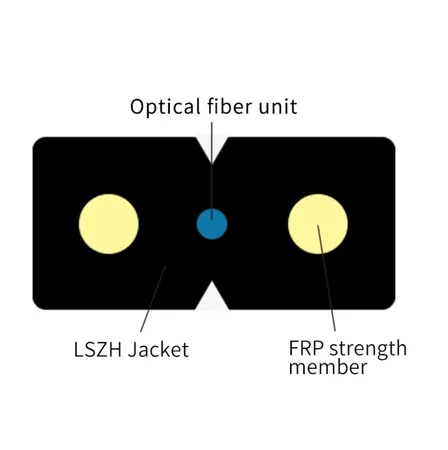
FBR-OBK-SM-G-1CORE-MT
FTTH Fiber Optik Drop Cable 1 Core LZSH
$0.08

FBR-OBK-SM-G-1CORE-1KM-IN
FBR-OBK-SM-G-1CORE-1KM-IN
$68.00
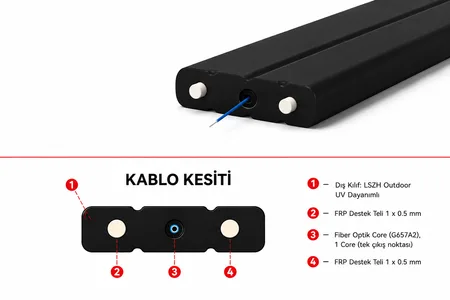
FBR-OBK-SM-G-1CORE-IN
FTTH Fiber Optik Drop Cable 1 Core LZSH 2KM
$89.00
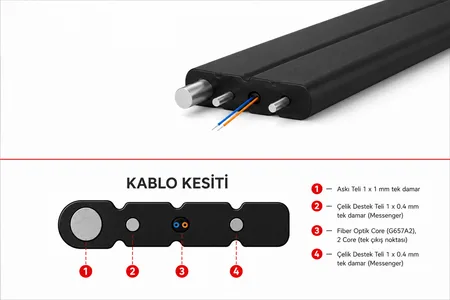
FBR-OBK-SM-G-2CORE-1KM
FTTH Fiber Optik Drop Cable 2 Core LZSH - Outdoor - 1000 Metre
$135.00

FBR-OBK-SM-G-8CORE-1KM
FTTH Fiber Optik Drop Cable 4 Core LZSH - Outdoor
$265.00
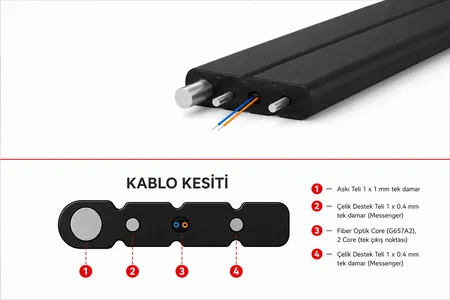
FBR-OBK-SM-G-4CORE-1KM
FTTH Fiber Optik Drop Cable 4 Core LZSH - Outdoor
$205.00
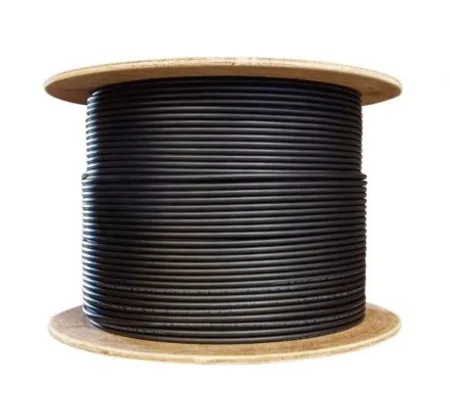
FBR-ADSS-24C-6C4T-2KM
FBR-ADSS-24C-6C4T-2KM
$1,690.00
Related Products
FBR-OBK-SM-G-8CORE-1KM
FTTH Fiber Optik Drop Cable 4 Core LZSH - Outdoor
$265.00
FBR-OBK-SM-G-4CORE-1KM
FTTH Fiber Optik Drop Cable 4 Core LZSH - Outdoor
$205.00
FBR-OBK-SM-G-2CORE-1KM
FTTH Fiber Optik Drop Cable 2 Core LZSH - Outdoor - 1000 Metre
$135.00
FBR-ADSS-24C-6C4T-2KM
FBR-ADSS-24C-6C4T-2KM
$1,690.00
FBR-OBK-SM-G-1CORE-IN
FTTH Fiber Optik Drop Cable 1 Core LZSH 2KM
$89.00
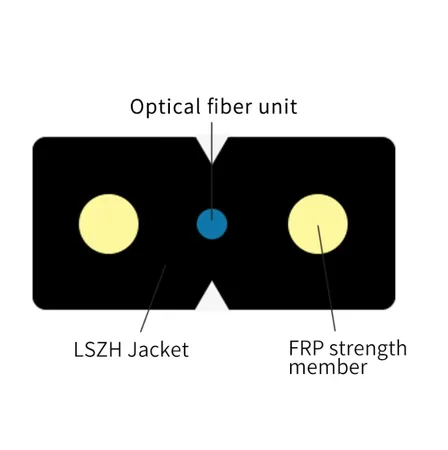
FBR-OBK-SM-G-2CORE-MT
FTTH Fiber Optik Drop Cable 2 Core LZSH
$0.10
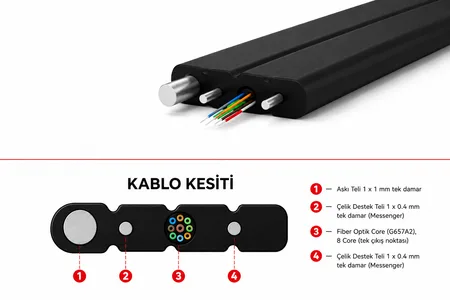
FBR-OBK-SM-G-4CORE-AA
FTTH Fiber Optik Drop Cable 8 Core LZSH - Outdoor
$235.00
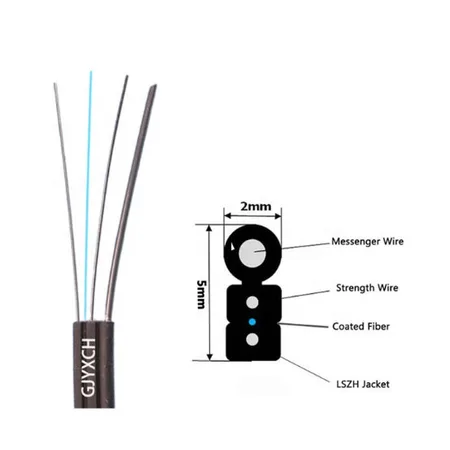
FBR-OBK-SM-G-2CORE-A
FTTH Fiber Optik Drop Cable 2 Core LZSH - Outdoor - 2000 Metre
$145.00